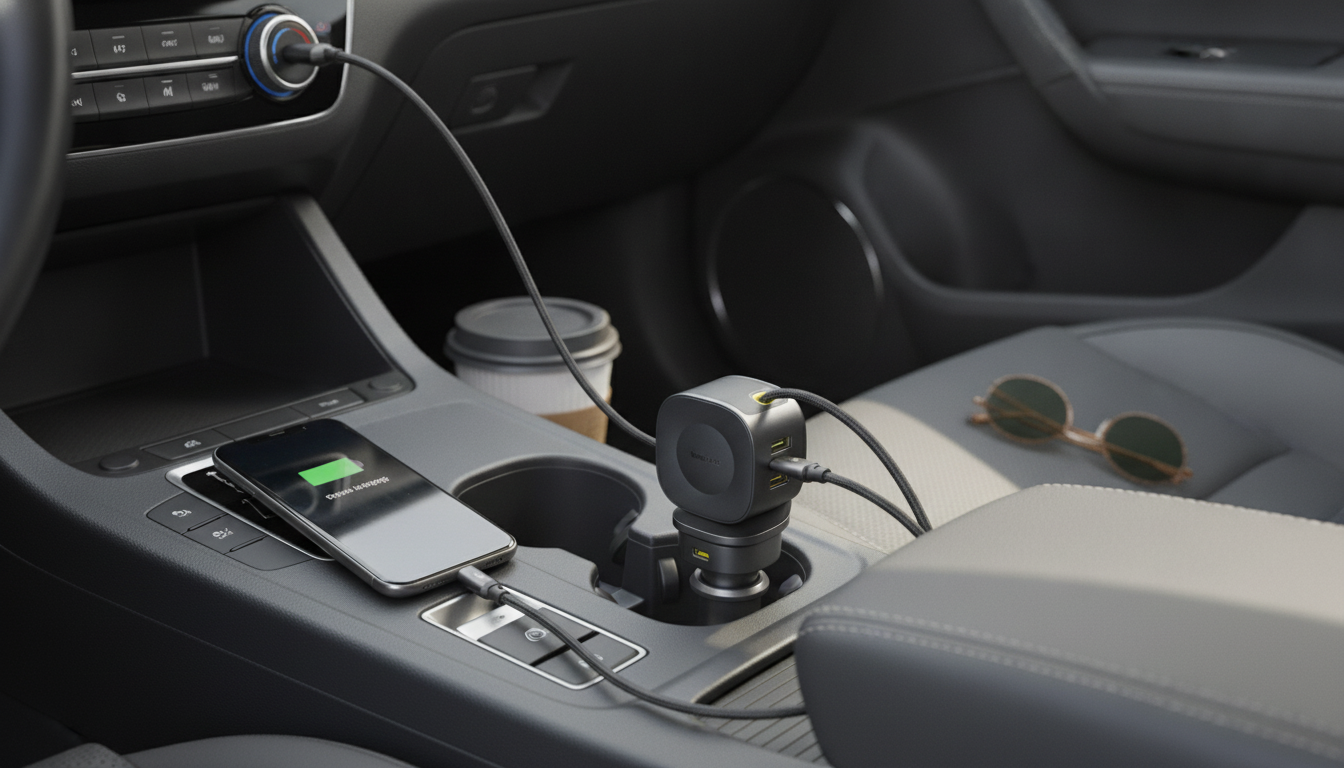
A high-output car charger can keep phones, tablets, handheld consoles, and even some laptops powered on commutes, rideshare shifts, and road trips—without a tangle of cords. The 240W 4-Port Fast Car Charger with Retractable Cable and USB Type-C Ports pairs multiple USB-C outputs with a built-in retractable cable so the cabin stays cleaner while multiple devices top up at once.
When a vehicle turns into a mobile office or a family charging hub, cable sprawl becomes the problem before battery life does. A retractable built-in cable reduces loose slack that can snag around the shifter, cupholders, and seat rails—especially helpful for carpools and rideshare vehicles where passengers connect and disconnect constantly.
With four total ports and high combined output, a single charger can replace the pile of splitters and multiple low-watt adapters that fight for space. It’s built for real driving scenarios: quick top-ups on short errands, sustained charging on long trips, and multi-phone work setups where navigation and communication can’t dip into low-battery territory.
The “240W” label refers to the combined maximum power the charger can deliver across its ports. Actual charging speed depends on how many devices are connected at once, what each device can accept, and which charging protocol gets negotiated (commonly USB Power Delivery for USB-C). For a deeper look at how USB-C charging negotiates power levels, see the USB-IF overview of USB Power Delivery.
In practice, high total wattage is most useful when multiple devices need power at the same time. Phones, tablets, earbuds, and accessories can charge together without everyone taking turns. For power-hungry devices—like some USB-C laptops—performance is typically strongest when fewer ports are in use so more of the total capacity can be dedicated to that single device.
| Setup | Typical devices | What to expect |
|---|---|---|
| Solo driver | USB-C phone + optional accessory | Fast top-ups with minimal sharing and steadier output |
| Two adults | Two USB-C phones | Convenient fast charging for both; check each device’s fast-charge support |
| Family trip | 2 phones + tablet + accessory | Balanced charging for everyone; charging speeds may vary per device |
| Work/rideshare | Multiple phones + navigation device | Less cable mess; consistent power delivery for several devices |
A retractable cable isn’t just a convenience feature—it changes the day-to-day usability of charging in a moving vehicle. Instead of stuffing extra length into a console or letting it trail under seats, the cable stays managed and ready. That makes it easier to “plug in and go,” particularly when passengers rotate in and out or when a driver is frequently docking and undocking a phone for navigation.
To extend cable life, avoid yanking at an angle, guide the cable back during retraction, and keep the connector tip free of dust and pocket lint.
Most modern fast car chargers are designed for standard 12V passenger vehicles and are often compatible with 24V systems commonly found in trucks—assuming the charger supports that input range. A firm, fully seated fit matters: a loose connection can cause intermittent charging, especially on bumpy roads.
USB-C has become the common denominator for modern devices, but “fast charging” isn’t universal. Each device decides how much power it can take and which standard it supports. Some phones use USB Power Delivery; others use proprietary methods or Qualcomm Quick Charge (learn more from Qualcomm’s Quick Charge overview). Charging multiple brands at once is generally fine because each port negotiates power independently, then shares the charger’s total capacity.
If a device seems slow, try a different port, disconnect other devices to reduce sharing, and confirm the device supports USB-C fast charging. Swapping to a known-good cable (for devices not using the built-in retractable lead) can also resolve inconsistent speeds.
For a lightweight home/office companion, consider the 65W GaN USB C Fast Wall Charger with Quick Charge. Keeping the wall charger in a work bag and leaving the car charger installed creates a simple “always ready” setup.
It can charge many USB-C laptops, but results depend on the laptop’s required wattage and whether other ports are in use. For the best performance, charge the laptop by itself or with only one additional device.
Fast charging depends on the phone’s supported standard (such as USB Power Delivery) and a proper USB-C connection. Some phones will charge normally but fall back to slower rates if they don’t support the same fast-charge protocol.
Many vehicles cut power to the 12V socket when the car is off, but some sockets remain live. If your socket stays powered, unplugging the charger when parked for long periods can reduce battery drain risk and unnecessary heat exposure.






Leave a comment