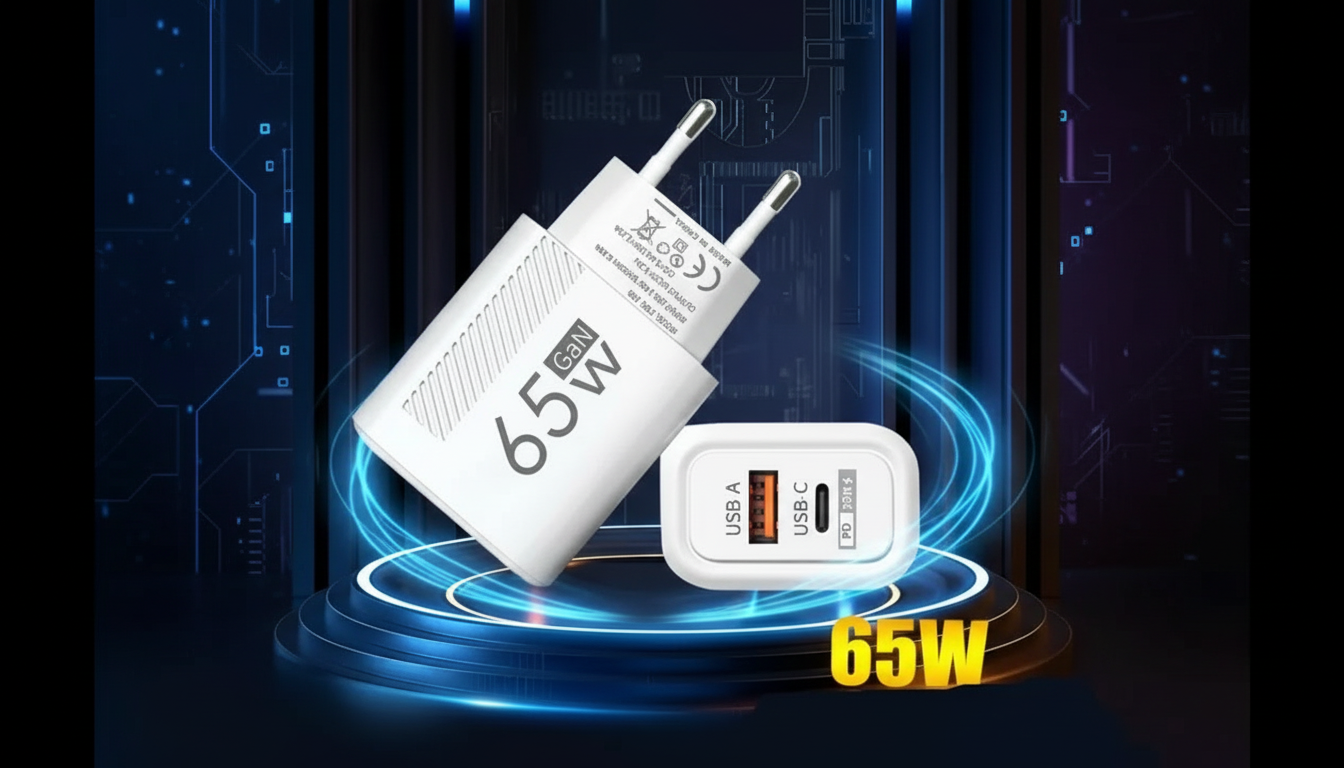
It depends on how the charger splits its 65W output and what each device asks for. Many 65W USB-C wall chargers can power two devices at the same time, but charging may slow down compared to charging each device alone—especially if both devices try to pull high wattage at once (like a laptop plus a tablet).
Most multi-port USB-C chargers use “dynamic power sharing.” When you plug in one device, it might get close to the full 65W (if it supports USB Power Delivery). Add a second device, and the charger reallocates power across ports using preset splits (common examples include 45W+20W or 50W+15W). That reallocation can reduce the wattage available to your first device, so its charge rate drops.
If one device is low-demand (earbuds, phone, smartwatch) and the other is moderate (tablet or ultrabook), a 65W charger often feels “full speed” for both because the combined demand stays under 65W. A phone might only take 18–27W, leaving plenty for the second device.
Slowdown is most noticeable when charging two power-hungry devices. For example, a USB-C laptop that can draw 60–65W may drop to 45W or less when a second device is connected, extending charge time. Some chargers also briefly renegotiate power (a quick pause or flicker) when a second device is plugged in.
Look for the charger’s port output table (often printed on the unit or listed on the product page). It will show single-port max wattage and the exact dual-port split. For a deeper walkthrough of 65W GaN chargers, USB-C PD behavior, and real-world charging expectations, see this 65W GaN USB-C charger quick charge and PD guide.
USB-C Power Delivery (PD) is the most common fast-charging standard for USB-C devices, especially laptops and newer phones. Quick Charge is a separate standard most often associated with certain Android phones and may require compatible chargers and cables to reach top speeds.



Leave a comment