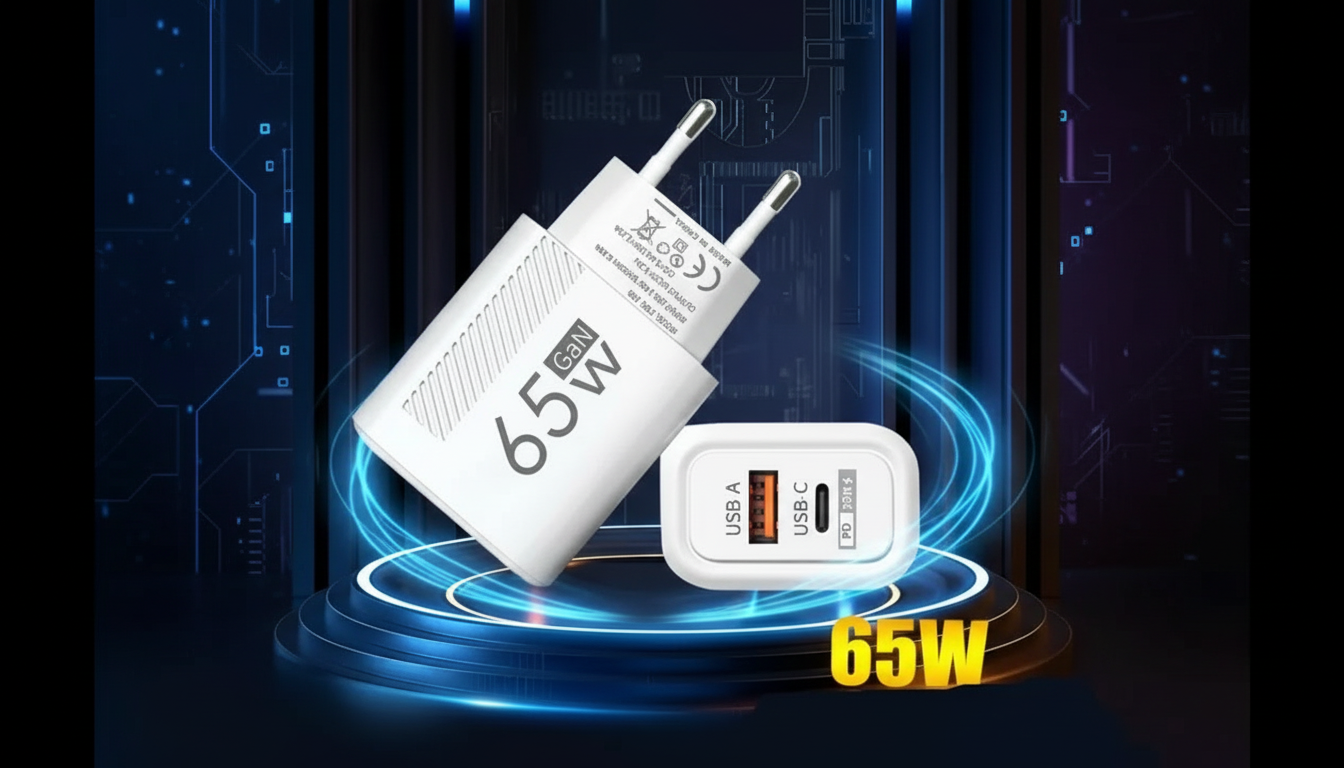
A multi-port 65W GaN USB-C charger doesn’t permanently “divide” 65W in half. Instead, it negotiates power with each device and then dynamically allocates wattage across ports based on what’s plugged in, which ports are used, and what charging profiles (like USB Power Delivery) each device requests.
When you connect the first device, the charger typically offers its highest single-port output (often up to 65W on a primary USB-C port). The moment you plug in a second device, many chargers switch into a dual-output mode with preset combinations such as 45W+20W, 30W+30W, or 50W+15W. These combinations come from the charger’s internal power budget and controller design, not from the cables.
USB-C Power Delivery (PD) works through a “handshake” where the device asks for a specific voltage and current (for example, 20V at 3.25A for ~65W, or 9V at 2.22A for ~20W). The charger then decides what it can safely provide to each port at the same time. If both devices ask for high power, the charger may cap one or both to fit under 65W total. If one device is nearly full or only needs a small top-off (like earbuds), the other device may get most of the wattage.
Some chargers also briefly pause output when a second device is connected so they can re-negotiate power on both ports. That can look like “charging restarted,” but it’s normal behavior as the charger recalculates its split.
For a deeper breakdown of PD profiles, port priority, and real-world charging scenarios, see the full guide: https://majorane.com/guide-65w-gan-usb-c-charger-quick-charge-pd-guide/.
Most multi-port chargers switch to a shared power mode when a second device is connected, so each port gets a smaller slice of the total wattage. The charger may also renegotiate PD profiles, which can temporarily interrupt and resume charging.



Leave a comment