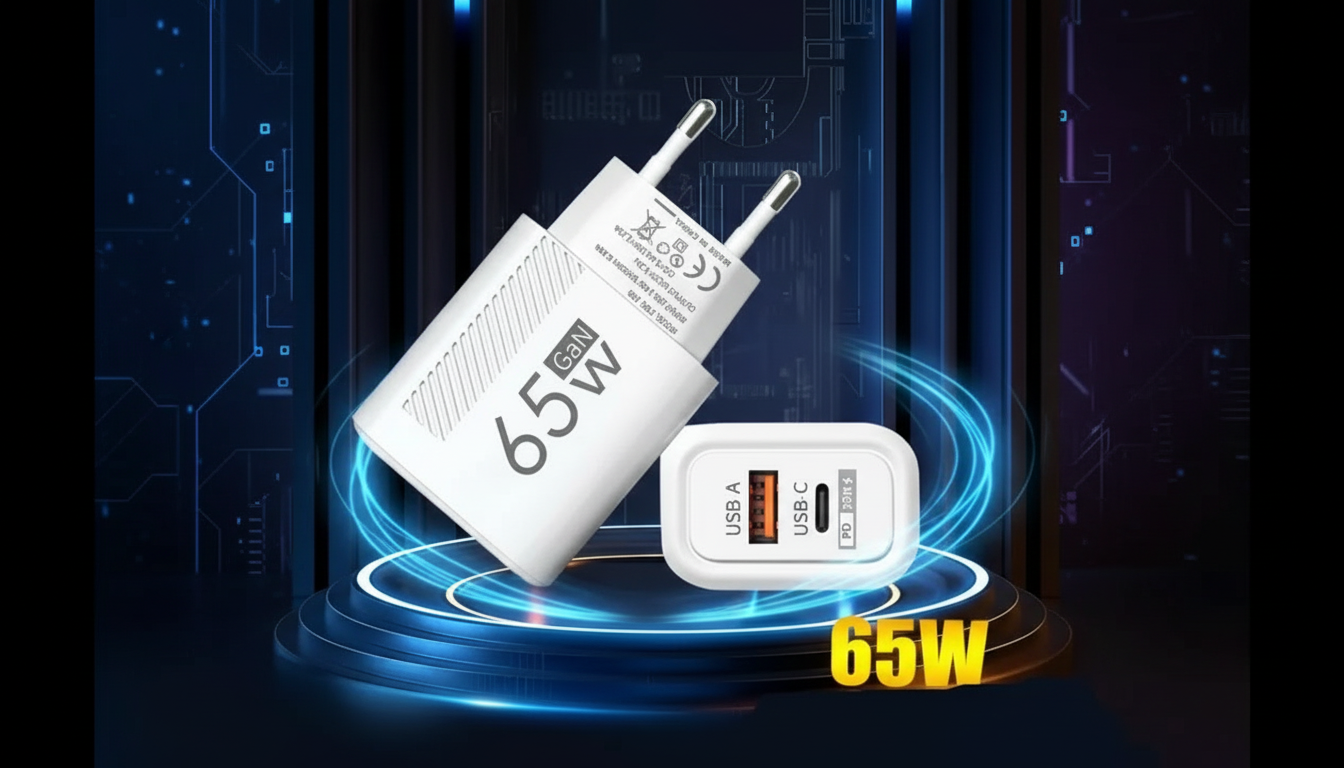
Usually, yes. If you want a reliable 65W USB-C Power Delivery (PD) charge, an E-Marker (electronically marked) cable is the safest choice because it tells the charger and device what the cable is rated to handle. Without that “ID,” many setups will still charge, but they may cap power to a lower level to stay safe.
USB-C charging power is a mix of voltage and current. 65W is commonly delivered as 20V at 3.25A. Cables that support 5A (often used for 100W charging) must be E-Marked, and many higher-quality 3A cables for fast charging are also E-Marked. Practically, buying an E-Marked cable reduces guesswork and helps avoid slow charging, overheating, or intermittent disconnects when running laptops, tablets, handheld consoles, and power-hungry phones.
If you’re charging a laptop that advertises 65W USB-C input, pairing it with a reputable PD charger and an E-Marked USB-C to USB-C cable is the most consistent way to hit the expected speed. For a deeper breakdown of 65W chargers, PD profiles, and what to look for, see the full guide here: 65W GaN USB-C Charger Guide.
Start with the product listing and packaging: look for phrases like “E-Marker,” “E-Marked,” “USB-IF certified,” “5A,” “100W,” or “PD 3.0/PD 3.1 support.” A cable advertised for 100W charging is effectively guaranteed to include an E-Marker because USB-C requires it at 5A.
If you already own the cable, the most accurate method is using a USB-C cable tester or a small USB power meter that can read cable/marker data. Some cables also print wattage (e.g., “100W”) on the jacket, but absence of labeling doesn’t prove it lacks an E-Marker.
Yes. The cable’s current rating and internal quality can limit how much power your charger and device will negotiate and deliver, especially at 45W–100W levels.




Leave a comment