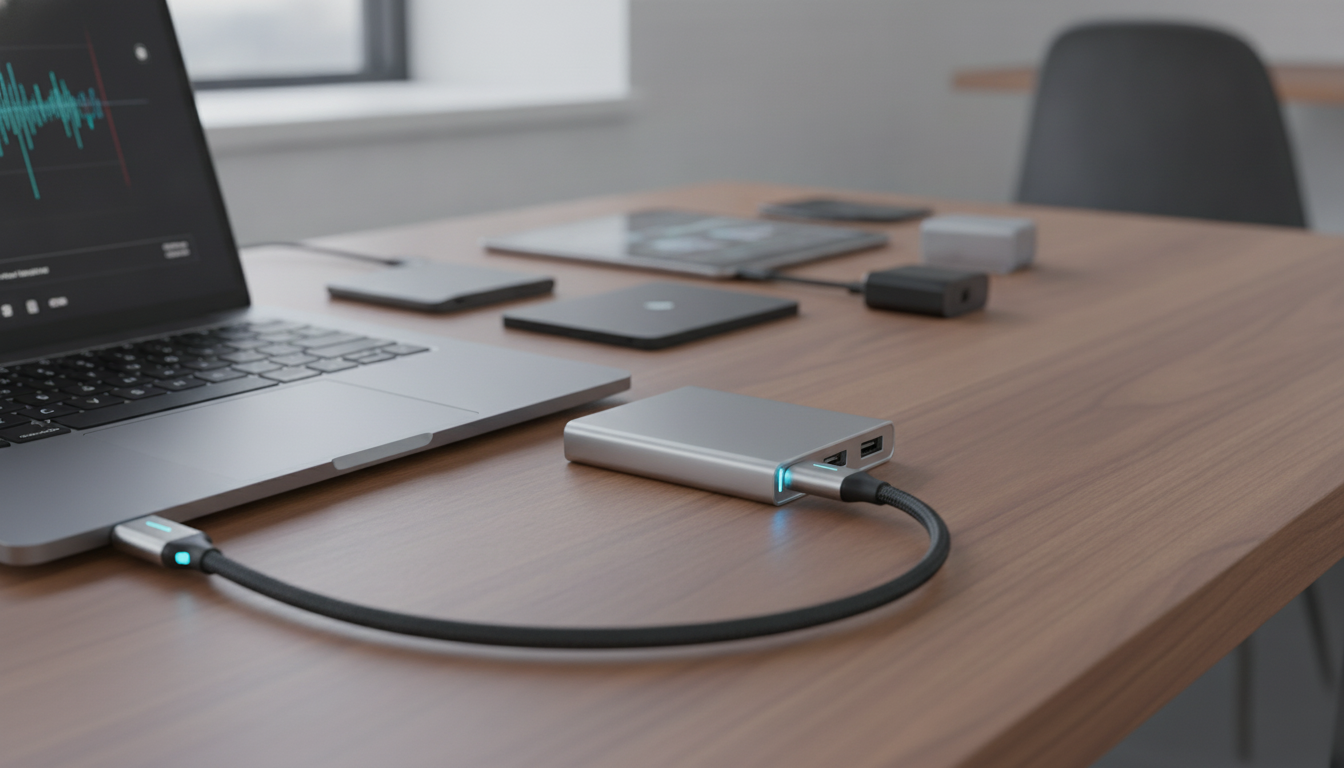
The fastest USB-C cable speed available today is up to 80 Gbps, enabled by certified USB4 Version 2.0 (also called USB 80Gbps). That top speed requires three things working together: a USB4 v2-capable host device, a compatible peripheral or dock, and a certified 80Gbps USB-C cable.
For most shoppers, the more common “fast” tier is 40 Gbps with USB4 (or Thunderbolt 3/4). Many high-quality USB-C cables and devices support 40 Gbps, and it’s enough bandwidth for fast external SSDs and high-resolution displays through a dock.
USB-C is the connector shape, not the speed. Cables that look identical can support very different data rates. The most reliable way to confirm speed is to check for official labeling on the cable or packaging (such as “USB 40Gbps,” “USB 80Gbps,” “Thunderbolt,” or “Certified”). If the listing only says “USB-C charging cable,” it may be USB 2.0 data speed (480 Mbps) even if it charges quickly.
A cable can be “fast” for charging but slow for data. USB-C cables can support up to 240W charging with USB Power Delivery (PD 3.1), yet still be limited to USB 2.0 data speeds. If the goal is both quick charging and high-speed data transfer, look for a cable that explicitly lists both the wattage (e.g., 240W) and the data rate (e.g., 40Gbps or 80Gbps).
In a car, charging performance is usually the priority, especially for laptops and modern phones. For a deep dive on choosing a high-output multi-port car charger and understanding cable considerations, see this guide: https://majorane.com/guide-240w-4-port-usb-c-car-charger-retractable-cable/.
No. “240W” describes charging capability, not data bandwidth. A 240W cable may still be limited to USB 2.0 unless it also states 10Gbps, 20Gbps, 40Gbps, or 80Gbps data support.






Leave a comment